pressure washing service near me zenith teamhealth
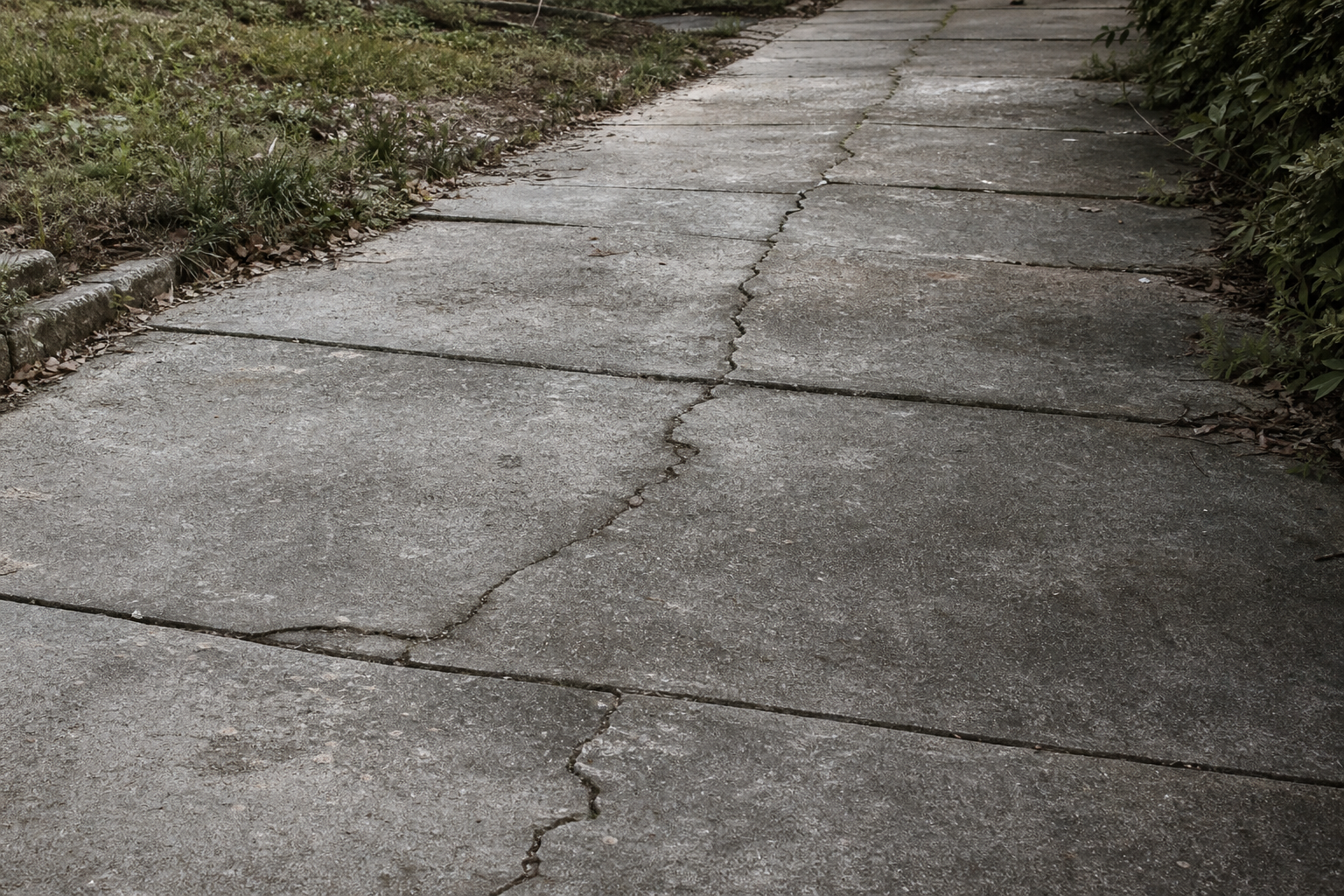
I walked the same path for years without registering what it looked like. The concrete outside my building had settled into my peripheral vision — a neutral strip between the door and the street, neither beautiful nor offensive, simply there. Then one afternoon the light fell at an angle I had never noticed before, and the surface looked almost unfamiliar. Dark seams. Pale mineral deposits. A faint green along the edge where water pooled after rain. I stood still longer than I meant to, trying to reconcile what I was seeing with what I remembered, and realized I had no memory of this place at all. Only habit.
I Thought It Always Looked Like That
Memory edits environments the way it edits conversations — keeping the emotional outline, discarding the specifics. I was certain the walkway had always been this uniform gray, the same flat tone from one end to the other. But photographs from three summers ago showed something different: lighter patches where sun had bleached the aggregate, darker lines where tires had crossed the apron. I had been walking across a record of weather and use without reading it.
What unsettled me was not the change itself but my failure to witness it. Surfaces do not announce their transformations. They accumulate them quietly — a winter of salt, a spring of pollen, a summer of dust that settles into the pores and stays. I had treated the path as scenery, not as material that lived through seasons alongside me.
I began to wonder how many other familiar places I had filed under "unchanged" simply because I stopped looking. The fence. The brick wall behind the parking lot. The concrete steps where I always cut the corner. Each one carrying a history written in stains and wear that I had never bothered to translate.
The Marks Became Part Of The View
Over time, discoloration stops registering as damage and starts reading as character. The dark streak below the downspout — I eventually stopped seeing it as a problem and started seeing it as part of the building's face, like a crease that forms beside an eye. The moss in the expansion joint became less an intrusion and more a detail, a soft green line in an otherwise hard geometry.
There is a strange comfort in this kind of forgetting. If you do not notice the marks, you do not have to reconcile yourself to the passage of time they represent. The sidewalk remains abstract — a path, a function — rather than evidence that years have passed while you were busy with other things.
But the marks were always there, waiting in plain sight. They had become background the way old furniture becomes background: present in every glance, examined in none. I understood then that familiarity is not the same as knowledge. I knew the route. I did not know the surface.
The Moment I Searched For Pressure Washing Service Near Me Zenith Teamhealth
It was not a practical impulse. I had no plan to hire anyone, no list of surfaces that needed attention. I typed the words into a search bar late one evening — pressure washing service near me zenith teamhealth — and sat with the results without clicking anything. The act felt less like shopping and more like naming something I had been circling for weeks: the desire to see a familiar place clearly again, as if for the first time.
The search results were full of promises I did not want. Before and after photographs. Urgency. The language of restoration as rescue. I closed the tab and looked out the window at the walkway below, still visible in the last light, still carrying its years of quiet accumulation. What I wanted was not someone to erase the history written there. I wanted to understand why I had stopped reading it.
That search became a bookmark in my mind — a point where observation turned into intention. Not to fix anything, but to pay attention differently. To treat the surfaces I passed every day as archives rather than obstacles, and to ask what they remembered that I had forgotten.
Details Returned To The Surface
Once I started looking, details emerged in an order I did not expect. Not the large stains first, but the small ones — a rust-colored spot the size of a coin, a hairline crack branching like a river delta, the way water darkened certain slabs after rain and left others pale. The texture varied block by block: some areas smooth from years of foot traffic, others rough where aggregate had loosened and washed away.
I found myself slowing down on a path I had always hurried across. Not because the surface had changed dramatically, but because my relationship to it had. I was no longer moving through a neutral corridor. I was moving across a document — one that recorded weather, seasons, the weight of objects dragged across it, the chemistry of air and water and time.
Nothing about the walkway's physical condition had transformed in those weeks. What shifted was my willingness to let it be specific rather than generic. The details were always available. They had simply been waiting for someone to stop treating familiarity as a reason not to look.
What Familiar Places Remember
Places do not forget the way people forget. A sidewalk retains every winter's salt, every summer's dust, every autumn's leaves ground into powder by passing shoes. It does not organize these memories into stories — it simply holds them, layered, visible to anyone who pauses long enough to read the stratigraphy.
I thought about other familiar places — the fence I passed without seeing, the brick wall whose color I could not have described accurately, the concrete steps worn smooth at the center by decades of feet taking the same shortcut. Each one a quiet archive. Each one altered by time in ways too gradual to trigger alarm, too persistent to ignore once seen.
I am still learning to look. Some days the walkway returns to background, and I catch myself mid-stride, already forgetting again. But the memory of noticing persists — a thin thread connecting me to the surfaces I walk across, the walls I lean against, the ordinary materials that outlast the attention I give them. They remember more than I do. I am trying to catch up.
Observations Worth Revisiting
What Still Catches My Attention
- The way morning dew darkens only certain stones, as if the path were selectively remembering the night.
- A crack that has widened by perhaps a millimeter since autumn — visible only if you know where to look.
- The fence post that leans slightly more each year, corrected by nothing but gravity and patience.
- Leaf stains that reappear in the same shapes every fall, a seasonal signature on permanent material.
- The difference between a wall in shade and the same wall in direct sun — two surfaces, one structure.
- Footprints dried into dust on a walkway no one claims to use anymore.
- The silence of a familiar corner when the traffic pattern shifts and no one explains why.
- How quickly the eye adapts to discoloration and begins to call it normal.